
 USA
USA
 USA
USA
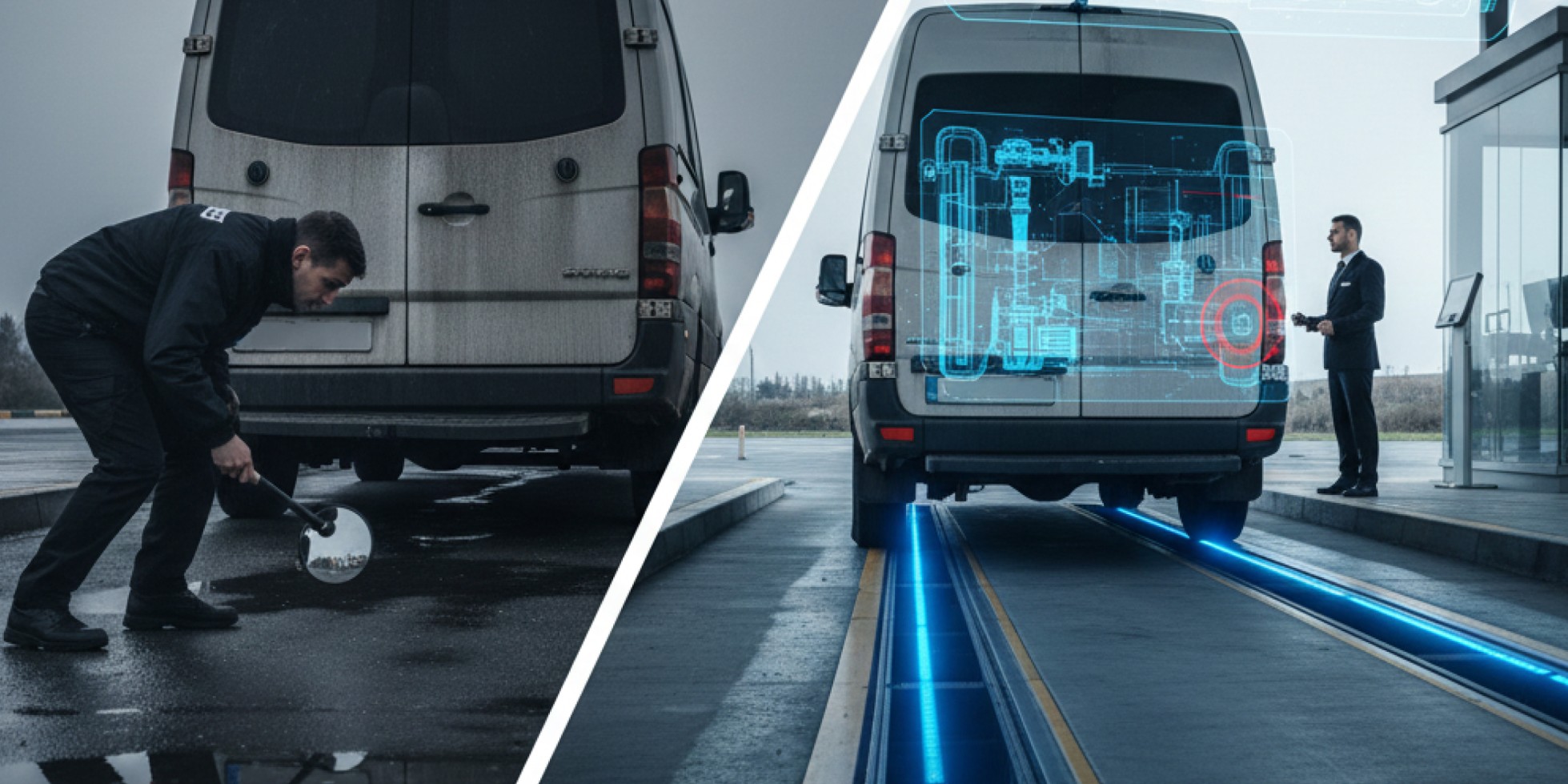
The challenges associated with performing a manual inspection of undercarriages, combined with the inability of manual inspections to provide consistent results across varying human skill levels, makes it unfeasible to use humans for this type of inspection in the future.
The limitations of manual inspections have resulted in increased human error and inconsistent threat detection, as guards will often miss items because of fatigue, distractions, and varying skill levels; these challenges have all resulted in increased threats to public safety and the loss of valuable time and money due to vehicle queue and congestion at the point of entry.
To overcome these types of problems associated with manual inspections, the only solution is to implement an Under Vehicle Inspection System (UVIS) with a proper technological infrastructure to provide the capability for the automated inspection of the undercarriage of vehicles.
These are the major advantages to using UVIS technology rather than relying on manual inspections.
– The inability to detect sophisticated or new threats
– Decreased preparedness against increasingly sophisticated security threats
Every vehicle is scanned by fixed high-resolution cameras with intelligent software so that there is no variance between human error due to inconsistent inspection methodologies, thus ensuring uniform inspection standards across shifts and locations.
Benefits:
– Reduction in human error
– Consistent inspection quality
Vehicles are scanned while the vehicles drive over the inspection lane (time varies from seconds). The vehicles do not have to stop at all nor do they take up much space.
Benefits:
– Traffic flows smoothly
– Increased checkpoint efficiency
– Improved visitor/staff experiences
UVIS provides high clarity and detailed images of the entire undercarriage of a vehicle, including those areas that are not easy to see. With state-of-the-art lighting and advanced image enhancement, the UVIS performs reliably in low-light and/or inclement conditions.
Benefits:
– 100% image coverage of the undercarriage
– Better detection of concealed objects
Because UVIS is fully automated, there is no longer any need for staff members to crawl under the vehicles and/or work in a crouched position. This has greatly increased safety and productivity for the security staff member.
Benefits:
– Safer working environment
– Increased productivity & morale
The UVIS is a centralized repository for all inspection images, timestamps, and alerts. The UVIS provides a single point of access for all of this data, and it can be easily accessed during audits and compliance checks as well as for forensic research.
Advantages of utilizing the UVIS include:
– Strong audit trails
– Increased accountability and transparency
By integrating Artificial Intelligence (AI) and Anomaly Detection algorithms into modern UVIS platforms, we can designate alerts related to foreign objects, structural changes, or other malicious modifications on the UGV. This helps to improve our ability to identify both known and unknown threats.
Advantages of AI Integration into Threat Detection include:
– Proactive threat detection
– Improved preparedness against evolving threat environments
Although there may be a limited need for Manual Under Car Inspection in lower risk facilities, it is not acceptable in today’s fast-paced world of high volume, high quality, many security facilities require Quick, Accurate and Adaptive Under Car Inspections (UCIs). Therefore, in order to effectively conduct UCIs on the totality of a facility’s UGVs, UGV owners/operators must transition to using UVIS.
Manual Under-Cars Inspections present many obstacles: Human error, inefficiencies, safety concerns, and a lack of formal written records, where the UVIS provides quick UCIs, the greatest visibility into a facility’s UGV Security, the highest level of Safety, and intelligent monitoring of threat detection.
As the sophistication of security threats increases, and the need for facility operations becomes greater, the UVIS no longer constitutes a luxury item, but rather is a critical component of Perimeter Security Operations Strategy in the Modern Age.


