
 USA
USA
 USA
USA
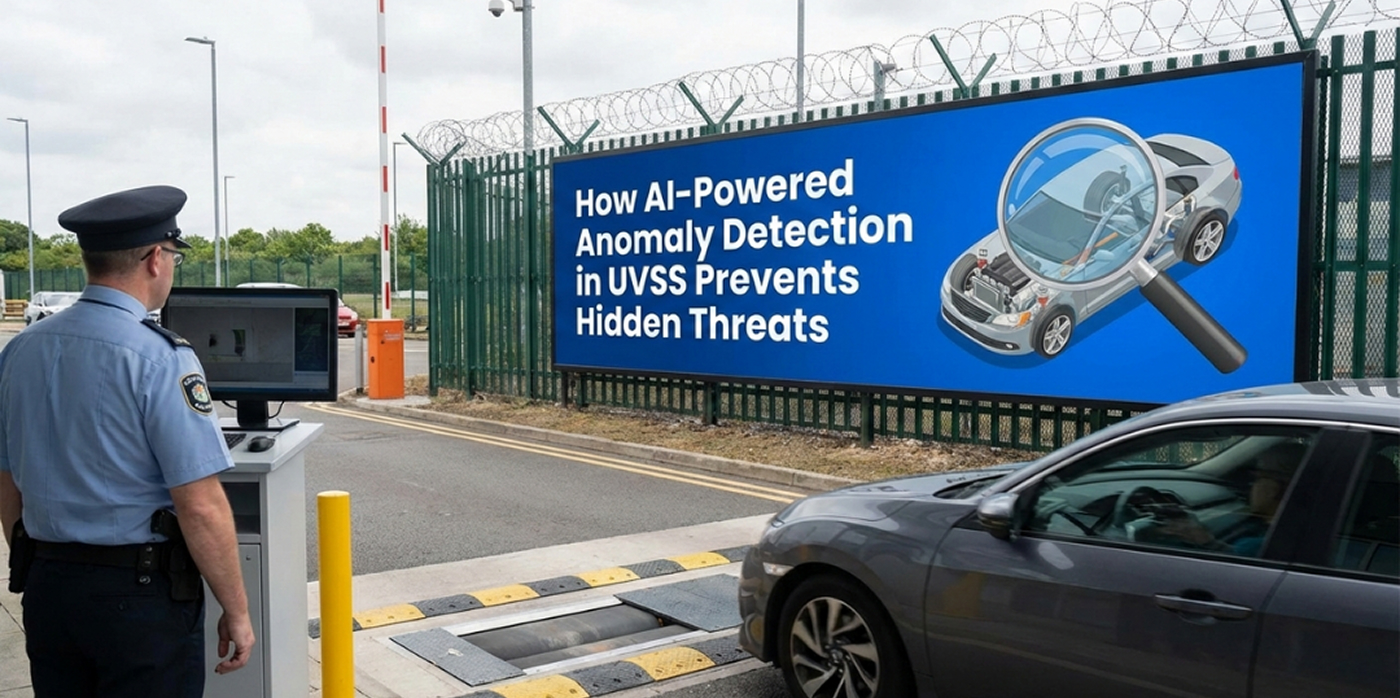
Modern threats are no longer obvious; contraband, explosives, or tampered components can be concealed deep within a vehicle’s undercarriage, often escaping manual vehicle inspection. Due to this, we have seen an unprecedented growth in Under Vehicle Surveillance Systems that are now being driven by the innovations and improvements of Artificial Intelligence. In this blog, we will uncover how AI-powered anomaly detection in UVIS prevents hidden threats
AI-powered anomaly detection transforms UVIS from a passive imaging tool into an intelligent threat-detection system. Fascinating thing is, AI-Powered anomaly detection in UVSS takes threat detection to next level by using machine learning to either identify unusual patterns, a structural deformation, leakage or a missing component of a vehicle.
AI-driven anomaly detection uses artificial intelligence and machine learning models to spot patterns or data points that fall outside normal system behavior. Unlike conventional analytical methods that rely on fixed rules or preset thresholds, these intelligent systems continuously learn and adjust as operating conditions evolve.
UVIS AI helps in spotting deviations in vehicle undercarriage components, like changes in vehicle profiles, concealed objects, or other irregular structures that could point to a potential threat. These anomalies aren’t always dangerous on their own, but they often serve as early warning signs that something in the vehicle isn’t quite right.
There are three important methods to consider in the definitions of UVIS AI systems. Depending on the type of system management requirements, a UVIS with integrated AI can be maintained as an automated tracking system, a system that includes a human in the loop, or an automated system that is updated independently by human intervention.
Dependent AI models are trained using labeled under-vehicle images that include known threats such as explosive devices, suspicious packages, or modified fuel tanks or chassis components. But there is a constraint that supervised models are limited to past encountered threats and do not work against new or unknown threats that went unrecognized by past detectors.
Automated learning plays a critical role in modern UVSS AI deployments. These models learn normal underbody structures across vehicle types and can detect subtle deviations without prior labeling. They can also identify unknown or emerging threats. This type of learning does not rely on labeled data. Because it can detect subtle and previously unknown irregularities, this approach is widely used in AI-based UVIS and is especially effective at border crossings and high-security checkpoints.
Semi-supervised UVSS models combine both approaches, learning from normal vehicle data while referencing limited threat samples. This balance improves detection accuracy, reduces false positives & maintains adaptability across diverse vehicle fleets
AI-based UVSS follows a step-wise process that converts data into useful insights. Each of these steps are based on the previous one combining data analysis, machine learning and contextual evaluation to emerge anomalies that may affect the real world.
Commport Technologies works on an automated AI model that provides high resolution images, captures of the undercarriage while the vehicle traverses over the scanning system.
CommPort Technologies UVSS AI is designed for real-world security environments where speed, precision and dependency are all critical.
By combining next generation technology and high performing area scanning, an AI-driven UVIS anomaly detection is a game changer. CommPort’s UVIS AI has rewritten the role of anomaly detection systems entirely. What was once just a visual inspection tool is now a complete intelligent security system. This platform is now capable of identifying and targeting unknown, and emerging threats in real time. As far as undervehicle-based threats are concerned, CommPort’s UVIS is no longer optional; it is now quintessential for modern security and inspections. By reducing manual errors and maximizing detection accuracy, Al-enabled UVIS stands as one of the competitive advancements for threat prevention.


