
 USA
USA
 USA
USA
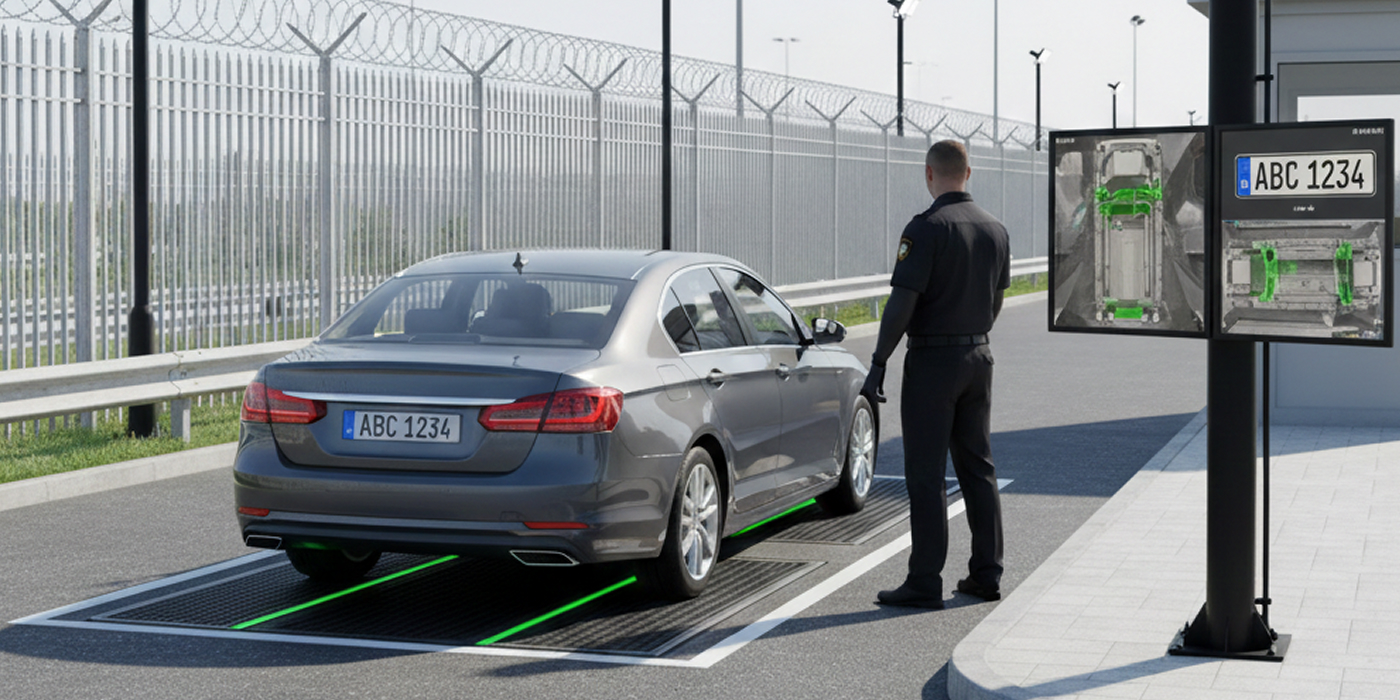
Modern security environments demand more than isolated inspection tools. Facilities managing high vehicle volumes such as airports, shipping ports, government/military complexes, oil refineries, large data centres, nuclear plants, prisons, electrical grid compounds and other critical infrastructure require intelligent & connected systems that can identify, inspect, track, and respond in real time.
By integrating License Plate Recognition (LPR) with Under Vehicle Inspection Systems (UVIS) or Under Vehicle Surveillance Systems (UVSS) and managing them through centralized platforms like CommPort’s CommBox Data console or AMS (Adaptable Matrix Software) organizations achieve a unified, data-driven approach to vehicle security at every access point.
The Under Vehicle Inspection System (UVIS) are specially designed devices that will provide a high-definition image of the undercarriage of a vehicle when that vehicle passes over the scanning surface. They are used to determine if there is any hidden contraband, weapons, modified structural items or foreign objects attached to the underside of a vehicle.
Unlike performing a manual inspection of the underside of the vehicle using mirrors, these systems are able to produce high-quality images while the vehicle is moving at full speed, and therefore can easily be used in environments with a high volume of vehicles.
License Plate Recognition, or LPR, also referred to as Automatic Number Plate Recognition (ANPR), is a method for automatically recognizing and reading license plate numbers from digital image captures of license plates. Thereafter, the LPR systems compare the license plate character string to several databases including, but not limited to, watchlists, access rights, or traffic logs for an immediate decision.
By adding LPR technology to UVIS, the under-vehicle imaging scanner becomes a smart, data-rich security/database gateway that adds a layer of identity authentication and positively improves the capability of image tracking and auditing. Listed below are the major benefits of using these technologies together:
When paired with a UVIS LPR, every under-vehicle image is associated with an individual vehicle’s unique identifier, which is the license plate number. This means that any under-vehicle record from a previous scan can be quickly retrieved by looking up the license plate number. Using CommBox or AMS, operators can instantly retrieve historical inspection data by plate number, date, time, or location.
When using LPR prior to an under-vehicle inspection, security professionals are now able to pre-screen a vehicle before it gets to the under-vehicle inspection point, or during the inspection itself. If a vehicle falls on a trusted list, then it can typically be allowed into the area with very little intervention; however, if a vehicle is on a watchlist, it will trigger an alert or secondary inspection. In addition, the integration of access control systems with LPR allows for the automation of gate operations and reduces the need for a manual decision.
CommBox or AMS enforces these rules consistently, reducing reliance on manual judgment while maintaining throughput efficiency.
When LPR and UVSS are utilized together, security professionals are provided deeper insight into the operations of their facility, and therefore are far better equipped to assess threats more expeditiously and make effective decisions regarding their operations when a large number of vehicles are entering or exiting their facility.
Manual inspection of under-vehicle scans is labor-intensive and subject to fatigue. By adding CommBox or AMS, the system can automatically flag vehicles with known risk profiles, prioritize scans requiring deeper review, and reduce unnecessary operator workload. This focused approach helps to minimize false positives and ensures security staff allocate their attention where it matters most.
CommBox increases the interoperability of the entire security ecosystem. When integrated with access control systems (gates, barriers, turnstiles), video management systems (VMS) & database watchlists or law enforcement feeds.
The result is a cohesive security architecture that responds dynamically to threats while maintaining throughput efficiency.
Many sectors are subject to stringent regulatory requirements regarding vehicle access, surveillance, and incident reporting (e.g., aviation security, border control, critical infrastructure protection). With LPR-linked UVSS logs tied to under-vehicle imagery, organizations can produce time-stamped, verifiable records, demonstrate compliance with security policies and simplify audit processes.
Integrating Licence plate recognition with UVIS managed through CommBox or AMS represents a modern best practice for vehicle access security. By linking visible identity with digitalized imagery of the vehicle’s undercarriage, organizations have the ability to enhance traceability, improve automated decision support, enhance threat detection, and provide an integrated experience for the end-user.
In short, this approach allows an organization to achieve complete security at their vehicle ingress points while establishing a cohesive, data driven defense that strengthens perimeter protection and investigations.


